

What Term Is Used To Describe The Genetic Makeup Of An Organism
Want a FREE PDF version of This Commodity?
Consummate the class below and nosotros will email you a PDF version of "Genotype vs Phenotype: Examples and Definitions"
Visitor Blazon*
Job Role*
Would you lot like to receive further e-mail communication from Engineering Networks?
Engineering science Networks Ltd. needs the contact information you lot provide to us to contact you about our products and services. Yous may unsubscribe from these communications at any fourth dimension. For data on how to unsubscribe, equally well equally our privacy practices and commitment to protecting your privacy, check out our Privacy Policy
Any organism is a by-production of both its genetic makeup and the environment. To understand this in detail, we must first capeesh some basic genetic vocabulary and concepts. Here, we provide definitions for the terms genotype and phenotype, discuss their relationship and take a look at why and how we might choose to study them.
What is the definition of a genotype?
In biology, a gene is a department of Dna that encodes a trait. The precise arrangement of nucleotides (each equanimous of a phosphate grouping, sugar and a base) in a factor tin can differ between copies of the same gene. Therefore, a gene tin can exist in different forms across organisms. These different forms are known every bit alleles. The exact fixed position on the chromosome that contains a particular gene is known as a locus.
A diploid organism either inherits two copies of the same allele or one copy of two different alleles from their parents. If an individual inherits two identical alleles, their genotype is said to exist homozygous at that locus.
However, if they possess two unlike alleles, their genotype is classed as heterozygous for that locus. Alleles of the same factor are either autosomal dominant or recessive. An autosomal dominant allele will always be preferentially expressed over a recessive allele.
The subsequent combination of alleles that an individual possesses for a specific factor is their genotype.
Genotype examples
Let's look at a classic example – eye color.
- A factor encodes eye colour.
- In this example, the allele is either brown, or blue, with one inherited from the mother, and the other inherited from the father.
- The chocolate-brown allele is ascendant (B), and the blueish allele is recessive (b). If the child inherits two different alleles (heterozygous) then they will have dark-brown eyes. For the kid to have blue eyes, they must exist homozygous for the blue middle allele.
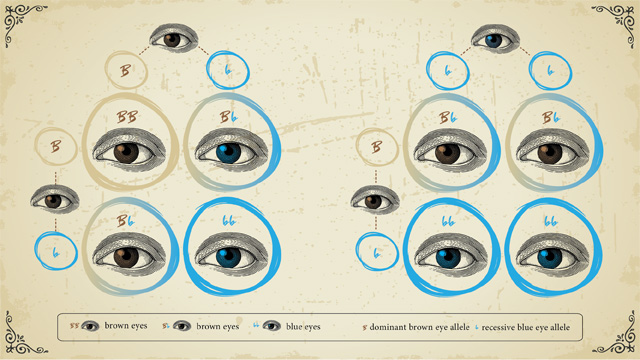
Effigy 1: Inheritance chart detailing how an individual may inherit blue or brown eyes depending on the alleles carried by their parents, with the brown eye color allele being ascendant and the blue middle color allele being recessive.
Other examples of genotype include:
- Pilus color
- Height
- Shoe size
What is the definition of a phenotype?
The sum of an organism's observable characteristics is their phenotype. A key deviation between phenotype and genotype is that, whilst genotype is inherited from an organism'southward parents, the phenotype is non.
Whilst a phenotype is influenced the genotype, genotype does not equal phenotype. The phenotype is influenced by the genotype and factors including:
- Epigenetic modifications
- Environmental and lifestyle factors

Figure 2: Flamingos are naturally white in color, it is only the pigments in the organisms that they eat that crusade them to turn vibrantly pink.
Phenotype examples
Environmental factors that may influence the phenotype include nutrition, temperature, humidity and stress. Flamingos are a classic example of how the surroundings influences the phenotype. Whilst renowned for existence vibrantly pink, their natural color is white – the pink color is caused by pigments in the organisms in their diet.
A 2d example is an individual'due south skin colour. Our genes control the amount and type of melanin that we produce, however, exposure to UV light in sunny climates causes the concealment of existing melanin and encourages increased melanogenesis and thus darker skin.
Genotype vs phenotype: observing
Observing the phenotype is uncomplicated – we take a look at an organism's outward features and characteristics, and form conclusions about them. Observing the genotype, however, is a little more than complex.
Genotyping is the process by which differences in the genotype of an individual are analyzed using biological assays. The data obtained can and so be compared against either a second private'south sequence, or a database of sequences.
Previously, genotyping would enable just fractional sequences to be obtained. Now, thanks to major technological advances in recent years, state-of-the-art whole genome sequencing.

Effigy iii: A workflow depicting the various steps of whole genome sequencing (WGS).
(WGS) allows unabridged sequences to be obtained. An efficient process that is increasingly affordable, WGS involves using high-throughput sequencing techniques such every bit unmarried-molecule real-fourth dimension (SMRT) sequencing to place the raw sequence of nucleotides constituting an organism's Dna.
WGS is not the only manner to analyze an organism's genome - a variety of methods are available.
Why is information technology of import to report genotype vs phenotype?
Understanding the human relationship between a genotype and phenotype tin be extremely useful in a variety of research areas.
A particularly interesting expanse is pharmacogenomics. Genetic variations can occur in liver enzymes required for drug metabolism, such as CYP450. Therefore, an private'southward phenotype, i.east. their ability to metabolize a specific drug, may vary depending on which form of the enzyme-encoding cistron they possess. For pharmaceutical companies and physicians, this noesis is key for determining recommended drug dosages across populations.
Making use of genotyping and phenotyping techniques in tandem appear to exist better than using genotype tests lone. In a comparative clinical pharmacogenomics study, a multiplexing approach identified greater differences in drug metabolism chapters than was predicted by genotyping alone. This has of import implications for personalized medicine and highlights the need to be cautious when exclusively relying on genotyping.
How can we report the relationship between genotype and phenotype?
Using fauna models such as mice, scientists can genetically modify an organism so that it no longer expresses a specific gene – known as knockout mice. Past comparing the phenotype of this animal to the wild type phenotype (i.e. the phenotype that exists when the gene has not been removed), we tin can report the part of certain genes in delivering certain phenotypes.
The Mouse Genome Computer science (MGI) initiative has compiled a database of thousands of phenotypes that can exist created and studied, and the genes that must be knocked out to produce each specific phenotype.
Genotype vs phenotype nautical chart:
| | Genotype | Phenotype |
Definition | The set of genes in our Deoxyribonucleic acid which are responsible for a particular trait | An organism's observable characteristics and traits |
Characterized by | Genotyping techniques such as WGS | Observing an organism's outward characteristics |
Depends on | The gene sequences an organism possesses | Genotype, PLUS epigenetics and ecology factors |
Inherited? | Yes | No |
Example | Genes encoding eye color | An private with brown optics |
Source: https://www.technologynetworks.com/genomics/articles/genotype-vs-phenotype-examples-and-definitions-318446
Posted by: cooperbariders.blogspot.com
0 Response to "What Term Is Used To Describe The Genetic Makeup Of An Organism"
Post a Comment