

Is There A Way To See How Many Units A Makeup Brand Sells
Beauty is one of the sectors where straight-to-consumer brands are taking a pb. The traditional marketplace for cosmetics seems to exist lacking in variety and accessibility while customers desire more than and meliorate solutions for their beauty needs. Direct-to-consumer democratizes the access to specialized products, high-end makeup and natural products, to proper noun a few consumer trends to watch. This is why nosotros accept every reason to believe more and more DTC beauty brands volition be successful.
To assistance smaller brands get there, we gathered data from the beauty brands we work with on a daily basis to make central ecommerce metrics benchmarks available.
The most of import ecommerce benchmarks for beauty brands the report covers:
- conversion charge per unit,
- customer retention rate,
- customer lifetime value (CLV),
- orders per customer,
- time betwixt orders,
- cart abandonment rate.
The report is based on the data of participating brands with their consent. It represents pocket-sized and middle-sized ecommerce dazzler brands from Europe and the US.
Read more: Best practices for DTC brands
The categories identified are: Men's, Haircare, Deodorant, Skincare, Makeup, Fragrance, Specialized, Total range and Retailer. *Retailers are included in the report because they act as DTC brands and requite admission to smaller brands not available from larger distributors.
Overview
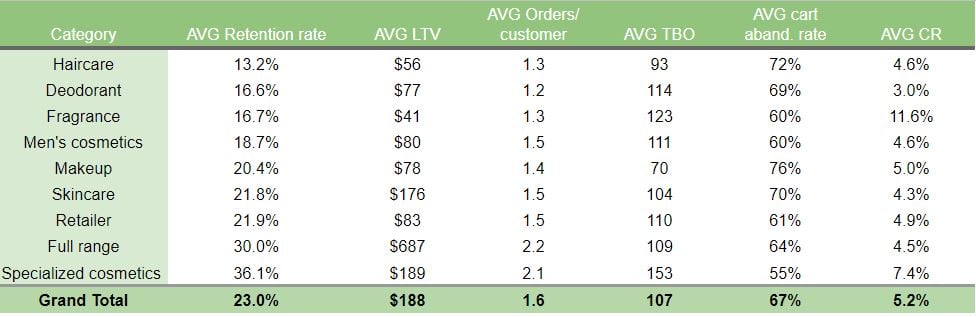
Overall, retention charge per unit is about a fourth of all customers, 23%, and means almost ane.half-dozen orders per customer on average.
The average customer lifetime value (LTV) comes out to $138 (all currencies converted to USD for comparing), with an boilerplate time between orders (TBO) of 107 days.
The conversion charge per unit of dazzler brands gravitates around 5.2%, while the cart abandonment charge per unit is, unfortunately, 67%.
Compared to the general ecommerce benchmarks provided in our previous written report, beauty brands are doing a bit worse than categories such as CBD, supplements or pet products.
Now let's get over the performance metrics in particular.
Client retention rate benchmarks for beauty brands
Beauty is a sector, notorious for customer disloyalty. This is due to two interconnected reasons: people believe cosmetic products stop working in a while and thus they are eager to endeavor new things in hope they'll work even amend: a new pilus color, a new aroma of perfume, a new confront mask, etc.
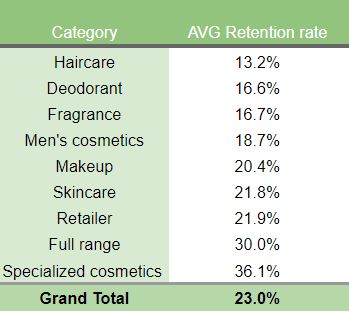
And nosotros see that in the data: the categories with the worst customer retention rate are Haircare (xiii.2%), Deodorant (16.half dozen%) and Fragrance (16.7%).
The get-go two are the ii near often defendant of stopping working, making people switch. It'south a well-known mantra that you should alternate different shampoos/ deodorants because your hair/ peel gets used to it and the effect diminishes.
Fragrance is a lifestyle category and while there are people who stick to i production for years and decades, others use perfumes as a part of the outfit, switching brands to match their current mood and styling desires.
On the other end of the spectrum are the Full range brands (30%, offer all major categories – Skincare, Haircare, Makeup – under their make proper name) and Specialized cosmetics (36.1%).
That's absolutely to be expected. Full range brands are created to the needs of their target grouping and when they deliver, people discover it easy to shop repeatedly. Having a one-stop store for your major corrective needs is incredibly user-friendly. The absolute winner hither is one brand with a 46% repeat purchase rate.
Read more on: How to get loyal customers when selling beauty products online
Specialized brands offer solutions for specific skin and skin problems: heavy acne, vitiligo, ultra sensitive skin. Their clients don't just shop for a shower gel, those dazzler products are almost like a medicine for their problems. That's why retention is predictable (those people demand the products all the time) and proves they piece of work. The highest private retentiveness rate hither is 43%.
Average Customer lifetime value (CLV) benchmarks for beauty brands
Client lifetime value (CLV, or simply lifetime value, LTV) is essential for ROI. It direct influences profitability and determines how much you can spend on customer acquisition without incurring a loss.
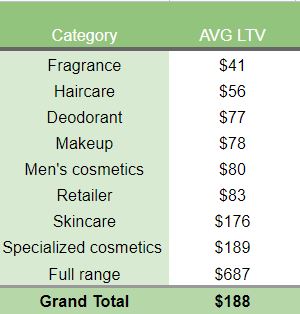
At the bottom of the report by CLV are the categories (again) Fragrance ($41) and Haircare ($56), which is expected with the sub-par retention charge per unit of theirs.
The CLV of Fragrance brands may seem low, but keep in mind that product prices are also very low compared to legacy brand'due south prices. That's why we don't compare average guild value (AOV) either.
Commencement, the report encompasses brands from many different countries and in diverse currencies. Second, prices are different depending on positioning, with DTC oftentimes offer a better price that retailers due to the shorter supply chain. So it doesn't make sense to compare brands on money value.
Only Special ($189) and Full range ($687) brands beat the industry average CLV of $188. They are, unsurprisingly, the ones with the highest retention rates.
All the same, this result proves that the bigger the pick, the more you can earn from each client simply because there's more to offer – Full range seems to be the most profitable way to go.
This whooping event, however is skewed by one huge outlier in our survey, a brand with a CLV of $1,929 (this brand also boasts 46% retention charge per unit and three orders per client on average). Without information technology, the average would exist $273, which is withal way higher up any other category.
Number of orders per customer benchmarks for dazzler brands
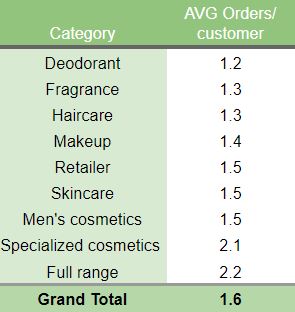
The overall boilerplate number of orders per customer in ecommerce we reported is 1.8. For beauty brands, it is i.vi, which is non far lower, just suggests the industry's abiding struggle to proceed customers.
Special (2.1) and Total range (2.2) brands are the best performing again.
Average fourth dimension betwixt orders (TBO) benchmarks for beauty brands
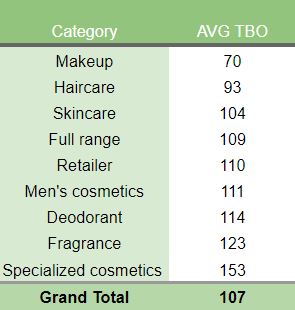
On this metric, finally, the best performing categories are Makeup (70 days), Haircare (93 days) and Skincare (104 days), while the boilerplate is 107 days.
Plain, the categories that don't manage to retain customers, manage to at least speed up the buying cycle – mayhap through variety in the production range.
Information technology is important to note that Special cosmetics and Fragrance take longer buying cycles – 153 and 123 days, respectively. This is a huge insight for email marketing because nosotros all tend to send reminder too oftentimes than needed. Customers demand more time to place their next order for some products and that's natural. Your email marketing strategy should have that into business relationship if you don't want it to backfire.
Read more: How to use Time between orders in email marketing
Average conversion charge per unit for beauty brands
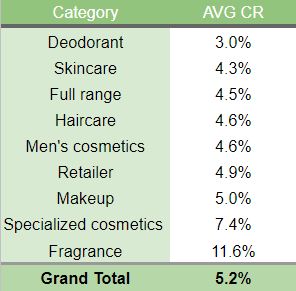
Once again, a surprise here. Fragrance performed twice higher up the average (xi.6% vs five.2%). It is partially due to the nature of the fragrance brands in the survey, all of which are vegan, cruelty-free and created for sensitive skin, which is a niche approach and, patently, appealing to consumers.
The bad results for Deodorant brands too stem from the nature of the product – people are just not sure it'd work for them. That'south why money-back guarantees or samples/ tryouts help, just as Native, the nigh successful DTC deodorant brand, does.
Acquisition sources for DTC beauty brands
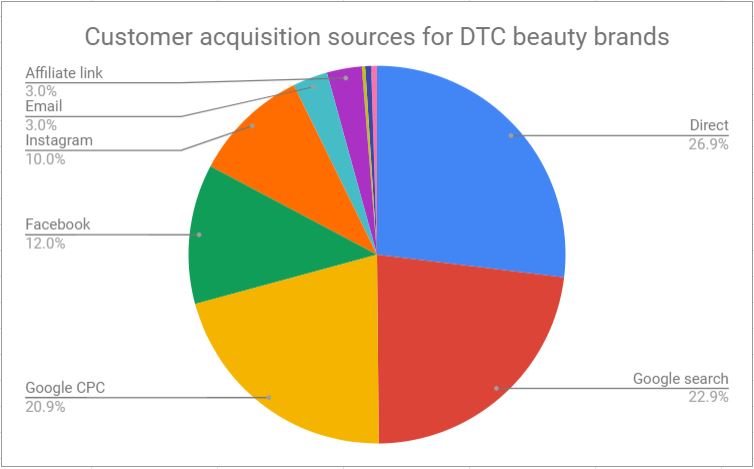
Our enquiry identified the best working client acquisition channels for this type of products: direct traffic, Google organic search and CPC.
Facebook and Instagram, surprisingly, fall behind in bringing in sales.
What does this mean? Information technology means that most brands get most of their orders from people who directly blazon in the make site. Those people are familiar with the make and don't waste time looking around. That's why information technology's essential to imprint your make in the customer'due south mind.
*Note that the research is based on the companies' data reported by Metrilo, which makes information technology possible to track the acquisition channels for all orders, not only the starting time ane of every customer. And so this overview shows where virtually orders come equally a whole, non but the first conversion.
Takeaway tactics for dazzler brands
Hither are the most common tactics the beauty brands we surveyed utilise to get these results:
- Client retention is part of strategy from the commencement, not an afterthought.
- Offer more variants in society to go along customers coming back and trying new products within the brand.
- Add new products categories to lock people for even longer.
- Use samples however you can.
- Paid sample bundles also work for bumping up order value, which in turn affects LTV and may lead to higher retention. And people exercise society them.
- Time your email marketing in accordance with customer buying cycles (TBO)
- The better your brand is aligned with the values of your target audition, the higher the conversion rate will be. Existence niche is all-time.
- Influencer marketing doesn't seem to work so your marketing coin is all-time spent elsewhere.
- Invest in make sensation and long-term brand building.
- Loyalty clubs make sense.
Source: https://www.metrilo.com/blog/beauty-brands-ecommerce-benchmarks
Posted by: cooperbariders.blogspot.com
0 Response to "Is There A Way To See How Many Units A Makeup Brand Sells"
Post a Comment